|
For holiday cottages in the UK and Ireland; find your perfect holiday rental property in Holidaycottages.cc or on this website, then contact the owner directly to arrange your booking.
|
|
|
|
Dawdling in Dingle
 From
his comfortable cottage base Peter Henshaw slowly discovers the beautiful
Dingle Peninsula in south west Ireland. From
his comfortable cottage base Peter Henshaw slowly discovers the beautiful
Dingle Peninsula in south west Ireland.
Fungie the celebrity dolphin was proving elusive. We'd been out in
Dingle Bay for the best part of half an hour, scanning the choppy water
for the sight of a fin or his smiley snout. Perhaps, being a true celebrity,
he wanted to keep the camera-wielding papparazzi hungry. He apparently
arrived on the south-west coast of Ireland 20 years ago, liked it, and
stayed. Since then, Fungie has become one of the Dingle Peninsula's
biggest tourist attractions. Boat trips out to catch a glimpse of him
cost around £6 a head.
So half a dozen boats were out there in the bay, each one full of camera-clicking
tourists. Suddenly, someone spotted a fin, and all six boats surged
towards it. Engines roared, our vessel lurched and all six boats began
to converge on the same spot. I could see the headlines: "Bizarre
six boat pile-up in Dingle Bay. One hundred cameras ruined. The only
witness was a dolphin who couldn't stop laughing."
But we hadn't come to Ireland to see dolphins. The chance of a self-catering
holiday on the Dingle peninsula – as far west as you can go in
Europe without getting your feet wet – was too good an opportunity
to miss. Besides, I could claim some distant Irish ancestry (along with
40 million Americans, so I'm told).The promise of rugged coastline,
live music and the odd pint of Guinness sealed the deal.
The English disease
 "Are
you English?" The landlady peered round the door of the B&B
at us. "Then I have to explain about the Euro." Yes, if there's
one thing the English are famous for these days, it's failing to understand
the common currency used by almost everyone in Europe except us. Mind
you, it can be confusing in Ireland, where the old Punt used to be roughly
on a par with sterling. With a Euro worth about 60p, everything looks
more expensive than it really is – 54 Euros for bed and breakfast
translated into a very reasonable £18 each for a spacious en suite
double room, with breakfast. An Irish breakfast, by the way, seems much
the same as an English one, but with an extra sausage thrown in. "Are
you English?" The landlady peered round the door of the B&B
at us. "Then I have to explain about the Euro." Yes, if there's
one thing the English are famous for these days, it's failing to understand
the common currency used by almost everyone in Europe except us. Mind
you, it can be confusing in Ireland, where the old Punt used to be roughly
on a par with sterling. With a Euro worth about 60p, everything looks
more expensive than it really is – 54 Euros for bed and breakfast
translated into a very reasonable £18 each for a spacious en suite
double room, with breakfast. An Irish breakfast, by the way, seems much
the same as an English one, but with an extra sausage thrown in.
We'd just come off the Rosslare ferry, and didn't fancy attempting
the 220-odd miles to our rented cottage at Dingle overnight, so followed
one of the many B&B signs pointing off the main road. Taking a ferry
to Ireland involves several options, and we had the choice of Swansea-Cork
or Fishguard-Rosslare. We opted for the latter, with Stena Line –
it involves more driving at either end, but less time on the ferry.
Not that we were driving, my day job is writing for a motorcycle magazine,
and we'd been lent a Suzuki Burgman 650 for the trip. This is a new
breed of machine, a sort of scooter-on-steroids, which supposedly combines
motorcycle performance with scooter convenience. Which it did, at 60mpg.
On Irish roads
 Not
that Irish roads give you much chance for speeding. It's a bit like
going back to how England was 30 years ago, when the traffic was lighter
and less manic, and bypasses were few. Dual carriageways are rare, motorways
non-existent. And most of the drivers seem to have been to charm school,
politely pulling over onto the hard shoulder to allow faster traffic
to pass. It's all very nice, but come here with a motorway mindset and
you'll need to allow more time for travelling. What with taking the
scenic route, following the Blackwater Valley through Lismore, Fermoy
and Mallow, those 220 miles took us all day. Not
that Irish roads give you much chance for speeding. It's a bit like
going back to how England was 30 years ago, when the traffic was lighter
and less manic, and bypasses were few. Dual carriageways are rare, motorways
non-existent. And most of the drivers seem to have been to charm school,
politely pulling over onto the hard shoulder to allow faster traffic
to pass. It's all very nice, but come here with a motorway mindset and
you'll need to allow more time for travelling. What with taking the
scenic route, following the Blackwater Valley through Lismore, Fermoy
and Mallow, those 220 miles took us all day.
But it was worth it. This is a beautiful part of Ireland, and we passed
several modest mountain ranges as we headed west. Then the land opens
out and you're skimming along a narrow road with Dingle Bay on your
left, mountains on the right – you can see why this area has become
so dependent on tourism. Every other cottage seems to be a B&B,
or café, or craft shop, but there's still a relaxed air about
the place. Walking into one cottage-come-café we took a wrong
turn and found ourselves in the living room, where a middle-aged man
was just settling down with his newspaper. "Oh, you're all right.
The tea room's through there."
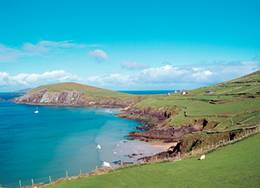
Rugged coastline, tea shops and tourists. This is Cornwall, without
the pasties or pixies. The best way to see that coastline is to follow
the Slea Head Drive, a 35-mile circular route signposted from Dingle
town around the very edge of Slea Head. It's a spectacular road, narrow
and twisty with sheer cliff on one side, a sheer rock face on the other.
You get panoramic views of Dingle Bay and a sparkling blue open sea,
which looked more Aegean than Atlantic when we were there. I'm reliably
informed that the weather isn't always so kind. From here, you can take
a boat trip out to the Blasket Islands (about £12 return), which
is good for walking and sea bird watching.
Be active
If you don't fancy driving, the Dingle Way footpath traces its way
along the coast here, or you can hire a bicycle in Dingle's only cycle
shop. Lots of cyclists do the Slea Head Drive (hard work, but worth
it), and you get more of a feel of the place than gazing through a car
window. So that's what we did, and one high point of the whole trip
was freewheeling back down the coast road as dusk fell and a golden
sunset filled the Atlantic horizon.
We'd pedalled up to the Stonehouse Restaurant to try some of the seafood
which is a speciality around here. Needless to say, most of it is locally
caught, and the tempura of lemon sole, and the baked salmon on sweet
potato, were both as good as they sounded. Nor did they break the bank,
at £10 a head. However, Ireland has its culinary duds, just like
anywhere else. A 'baked potato with cheese' in a Tralee café
turned out to be a flabby skinless thing, surmounted by a processed
slice of orange plastic. And this from a nation that built itself on
the potato!
Watersports, music and views
To go with the seafood, watersports are big around here, especially
on the north side of the Dingle Peninsula, reached from Dingle via the
stunning Connah Pass. Windsurfing, sailing, canoeing and diving are
all on offer, with or without tuition. The Dingle Tourist Office will
point you in the right direction. You can book boat trips there too.
If Fungie doesn't appeal, you could try deep-sea fishing, or a two-hour
trip along the coast for a spot of bird and cliff watching. Inland,
there's pony trekking and a choice of golf courses.
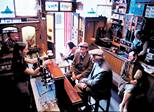
This wouldn't be Ireland without some foot tapping traditional music,
and Dingle is full of it. On a summer evening, the sounds spill out
onto the pavement, and it's just a case of following your ears. No one
seems to worry about closing time here – when we left Paidi O'Se's
at 11.30pm, things seemed to be just getting going ...
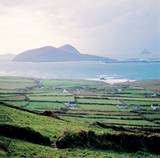
But in the end, the best way to appreciate the Dingle Peninsula is
to walk up Eagle Mountain, as we did on our last day. From here, you
get a panoramic view of the coast, the bay and the ocean. It was hot,
clear and still. Walking back down, we met a farmer and his dog, taking
a rest by the side of the track. "Do you know, I've been to America,
but there's no view like that in the whole world." He looked out
over the bay: "Nothing compares to Dingle on a day like this."
Search
for cottages in Dingle and the Republic of Ireland:
Photos courtesy
of: Bord Failite Photographic
|
|
|
|