Holiday cottages UK and Ireland: Essex pearls
 |
|
|
|
|
|
|
|
|
|
 |
 |
|
|||||||
 |
 |
 |
 |
 |
 |
|
|||
|
|
Essex pearls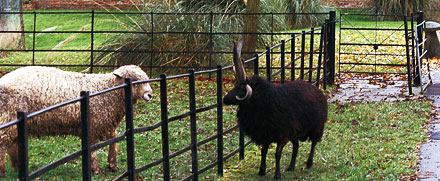
Sheep graze Layer Marney’s parkland We thought about continuing our research with a visit to Hollytrees Museum, which picks up Colchester’s story where the Castle Museum leaves off, but all this history had made us hungry and, although the city has plenty of restaurants and pubs, we had something special in mind. 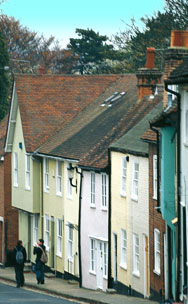
Colchester’s candy-coloured Dutch Quarter Checking the tide times, we set off across the causeway to Mersea Island in the estuary of the rivers Blackwater and Colne. Following the West Mersea coast road past a glorious hotch-potch of upturned hulls, gleaming yachts and weather-beaten fishing boats, we had no trouble spotting our goal. Run by Richard and Heather Haward, Company Shed is a fishmonger-cum-eatery and even on a dull November afternoon a small queue hovered expectantly by the door. As its name implies, the setting is a simple wooden hut and the only concessions to fine dining are waxed tablecloths, assorted tumblers and rolls of kitchen towel. Customers bring their own bread and wine, Heather provides the rest – juicy oysters from beds tended by eight generations of Hawards and a tantalising selection of fish and shellfish fresh from the tide. For just £8 each we feasted on a platter of dressed crab, lobster claws, smoked salmon, smoked mackerel, cockles, mussels, salmon terrine and prawns. “If you love seafood, Company Shed will transport you to heaven,” is how one reviewer described it. We do, and it did. We returned to the coast later on our weekend break, but this time our destination was Maldon, a lively market town with a history stretching back more than 1,000 years. In its heyday it was an important port and although some of its venerable timber-framed houses have disappeared behind modern façades, others have survived the centuries intact. These are not the only reminders of days gone by. We were particularly taken with the 12th century church of All Saints with its unique triangular tower and parade of local heroes dating back to Saxon times carved into the buttresses of the south wall. From here we went down the steep hill to Hythe Quay, home to several beautifully-restored Thames sailing barges, to end the day with a stroll along the sea wall. Looking back across the mud flats to the town as it blurred into a jumble of pastel colours in the fading light, it struck me that its understated prettiness was typical of Essex. If you’re after grand spectacle and rugged drama, this isn’t the place for you. If you like exploring hidden corners, refreshingly free of souvenir shops and tourist coaches, it is. 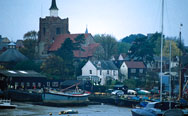
Malden at twilight – a lively market town The same thought crossed my mind the following morning when we delayed our journey home with a detour along the North Blackwater Trail. We didn’t have time to walk the 12 miles from Tollesbury to Heybridge Basin, but we dipped in and out to enjoy the solitude and the scurrying skies. With its lock and 18th century cottages, Heybridge Basin looked pretty and the canal bristled with craft of all shapes and sizes, from sturdy barges to swish yachts. Still loath to leave, we took a window seat in The Old Ship Inn and watched some of the estuary’s bird population feed in the marsh flats or line up in rows on the rigging of fishing boats moored in the mud shallows. “It’s a lovely little spot, isn’t it?” said a man at the next table. We agreed and reflected on the varied experiences we had squeezed into one weekend without ever straying more than 12 miles from Layer Marney. When we eventually hit the road we were already planning our next trip. Should we base ourselves in Frinton and combine the pleasures of the seaside with the pastoral charms of Constable Country? Or head west to explore the villages and windmills around Saffron Waldon and visit the Jacobean mansion of Audley End House? Perhaps we’ll do both. Watch this space. Did you know? Covering 350 miles, the meandering Essex coastline is the longest of any English county. The Blackwater Estuary, a Site of Special Scientific Interest, provides a winter refuge for 15 per cent of the world’s wildfowl. Where we stayedThe Tea House (above and interior below) at Layer Marney is a renovated Edwardian folly which has been converted into a detached, self-catering cottage. It sleeps four people and has a 4-star grading. Tel 01206 330784 or go to Essex onlineVisit Hollytrees Museum; the Natural History Museum and Tymperleys Clock Museum. |
||||||||||||||

 Online Magazine





|
|