Holiday cottages UK and Ireland: Islands on the Edge
 |
|
|
|
|
|
|
|
|
|
 |
 |
|
|||||||
 |
 |
 |
 |
 |
 |
|
|||
|
|
Islands on the edge … continued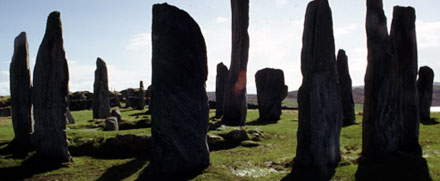
Callanish Stones We met in the ‘museum’ – a blackhouse kept just as it was in the 1950s, when the village didn’t have running water and electricity. “The original home would have had a fire in the centre of the room,” said Iain. “It kept the thatch dry and when it was replaced, the old thatch, full of soot, was put on the fields to fertilise the soil.” The residents of Gearrannan were almost entirely self sufficient. Many fished, but all depended on their croft for vegetables, animal fodder and roof straw. Cattle and other livestock lived at one end of the blackhouse and the family at the other – an arrangement that provided warmth and convenience but often led to diseases. But despite the harshness of the life, there was a strong sense of community. “Everyone helped when it was needed, such as cutting the turf for fuel in the spring,” said Mairi. “In the evenings, there would be friends and neighbours sitting by the fire and they’d have a ceilidh (traditional dancing) or tell stories.” 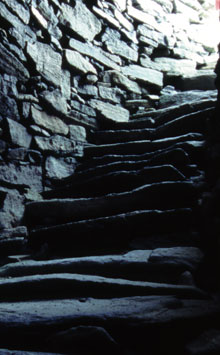
The stairway in Dun Carloway Gearrannan prospered for a while – there were 84 children at the local school in 1904 – but the Depression took its toll. The post-Second World War years saw high emigration until the last inhabitants – three elderly spinsters – moved out in 1974 and the blackhouses began to decay. Restoration by the Gearrannan Village Trust began in 1989 and has been completed at a cost of £1.25 million. Now, visitors can explore the village – run mainly by volunteers – and see demonstrations of traditional crafts, including butter making, spinning, and weaving the famous Harris Tweed. The design of the blackhouses has its roots in the Nordic longhouse. A restored Norse watermill near Gearrannan looks very similar to the blackhouses. The islands were under Norwegian rule until 1266 and evidence of this long occupation can be found in the Gaelic language, particularly place names. Human occupation goes back much further than the Vikings. The west coast of Lewis has some of the finest prehistoric monuments in Britain. Not far from Gearrannan is Callanish, a mysterious circle with two long avenues of stones laid out in roughly the shape of a Celtic cross. Built 5,000 years ago, the 50 monoliths stand some 15 feet high. Callanish lines up with 11 other megalithic sites, including two impressive stone circles within walking distance. Access to the stones is a pleasant surprise. There were few visitors and it was wonderful to be able to walk among – and touch – the stones. 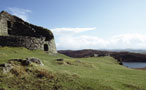
Dun Carloway, Lewis The same is true for another piece of history, Dun Carloway. Perched high above the coastline with panoramic views, this fortified tower – or broch – is in excellent condition and free to explore. Brochs – built during the Iron Age for defence – are constructed of two concentric dry-stone walls, with stairs between them giving access to the higher levels. It was apparently inhabited until 1870. There’s another substantial broch on the island of Taransay – just beyond Harris and the setting for a reality TV show, Castaway, a few years back. The contrast between these southern islands and Lewis is dramatic – they have sweeping bays of white sand and turquoise waters, protected by round-shouldered hills up to 2,293 ft high. Anywhere else in Britain, such stunning beaches would be filled with visitors, but here there is peace and solitude, as well as great beauty. 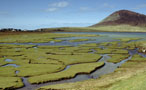
The famous grasslands of Harris's coastal valley -–a breeding ground for wading birds The main road through Harris passes the bays of Losgaintr (pronounced ‘Luskentyre’) and Taobh Tuath, both famous for the rare grasslands – machair – of Harris's coastal valleys. Hundreds of wading birds breed here, and golden eagles, and even the incredibly elusive sea eagle, can be seen. At dusk, you may hear the rasping rattle of the corncrake. Extinct in mainland Britain, it inhabits the wetlands of Lewis and Harris. Further around the coast, sits the stark and remote church of St Clement, thought to have been a religious site for at least 1500 years. The present church is 15th century and contains some of the finest mediaeval sculpture in the islands. Yet the magic of these islands doesn't lie in the sights, or even the scenery, but in that unique sense of place that is about warm hospitality, individuality and, for the southern visitor, a little frisson of adventure from a place that should be familiar, but isn’t. 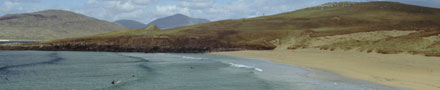
Surfing in Harris Want to know more?• Gearrannan Blackhouse Village has four-star self-catering cottages for rent. The smallest accommodates two people and the largest 16. Taigh Glass has been restored with the needs of the disabled visitor in mind. Tel 01851 643416; • Caledonian MacBrayne Ferries operate several routes between the Hebridean Islands. Tel: 08705 650000; e-mail: [email protected]; |
||||||||||||||

 Online Magazine





|
|