





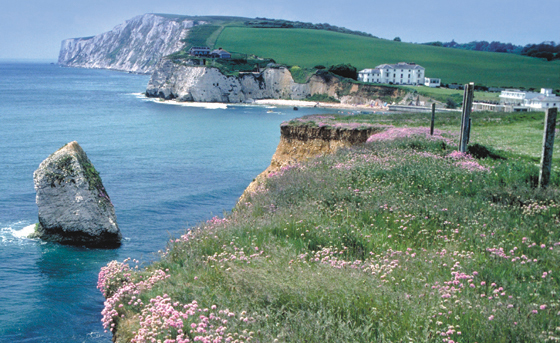
The Isle of Wight's coastline is one of its many striking features
 |
|
|
|
|
|
|
|
|
|
 |
 |
|
|||||||
 |
 |
 |
 |
 |
 |
|
|||
|
Holidaycottages.cc Isle of Wight
|
Walk the Wight way
The Isle of Wight's coastline is one of its many striking features With its wonderful countryside and 500 miles of footpaths, the Isle of Wight is ideal for a walking holiday. Harry Glass pulled on his hiking boots… “Walking – it’s the best way to see the island,” a lady tells me as we stroll with a group of 22 others along a ridge towards St Catherine’s lighthouse on the southernmost tip of the Isle of Wight. An hour later we’re standing on the rocks in front of the lighthouse, looking out to sea. Not long after we’re in a country pub enjoying a well-earned sit-down and a refreshing drink. We’re all here for the Isle of Wight Walking Festival, the largest event of its kind in Britain, with 180 themed and guided walks spread over 16 days every May. The incredible number of walks is a testament to just how much there is to see here. In fact, it’s great walking territory any time of the year with a boot-punishing 500 miles of footpaths criss-crossing the island, half of which has been designated an Area of Outstanding Natural Beauty. Wrapped in 60 miles of coastline – including two stretches of Heritage Coast – the island features striking white cliffs in the south and wildlife-rich salt flats in the north. "It’s great walking territory any time of the year with a boot-punishing 500 miles of footpaths criss-crossing the island" During the festival – an annual event since 1999 – you simply select a walk from the programme and turn up at the meeting point. Each walk is either an all-day event or lasts only one or two hours, leaving you plenty of time to do your own exploring. There’s a great variety of walks, from ones where you go ice cream tasting or follow a route rich in orchids or wildlife, to others where you get the low-down on the island’s past, from pirates to historic homes. The guides talk you through the walks, making your ramble an informative experience as you explore the island’s open downland, ancient woodland, secluded estuaries and rolling farmland. And as the Isle of Wight measures only 23 miles west to east and 13 north to south, it means that wherever your holiday cottage is, you’ll be able to get to any walk within an hour. More Isle Of Wight cottages ->  Cottages By County,
 Bramley Cottage,
Sandown Prices
 21 Ocean Gate,
Newquay Circular route from Niton, via St Catherine’s lighthouseFor my first walk, everybody met by The White Lion in the village of Niton, on the island’s south coast. We were led by our guide, John Gurney-Champion, through fields full of wildflowers to a high ridge back from the sea. On the shelf of land below we could see 19th century St Catherine’s lighthouse. Run by Trinity House, the General Lighthouse Authority for England and Wales, it has a visitor centre, plus the authority has three former lighthouse keepers’ cottages here which it rents out as holiday homes. Conversations sparked between strangers as we made our way down the wooded slopes towards the lighthouse. It was a sunny afternoon and everyone was enjoying the good company and the countryside. I chatted with John’s wife Elizabeth, who said word of the event was spreading worldwide as it grew in popularity. She had just met some walkers from Holland who’d come for the whole two weeks. This was backed up by an enthusiastic chap from Plymouth. “We come over every May for the festival,” he said. “We’ve met lots of people, including some Canadians. And we’ve done about 10 walks – 120 miles in all.” On our way back towards Niton, we walked through old smugglers’ tunnels and then stopped at a pub. “I usually have great trouble getting people away from The Buddle,” John said with a slightly concerned look. However, we were all well behaved and made it back to Niton in good time and none the worse for wear. The Osborne EstateMy second walk was a gentle stroll through the woods of the Osborne Estate – the favourite home of Queen Victoria and Prince Albert – and down to its private beach. Our guide was the head gardener, who gave us a fascinating commentary on the history of the garden and its many plants and trees. The estate once stretched over 2,000 acres but is now a mere 300 – still large enough, though, to require nine full-time gardeners. The royal couple bought the estate to develop it, but were advised against doing so because of the drainage problems caused by the clay soil. This didn’t stop them – they simply had 700 miles of drains installed! Of all the exotic plants and trees on the estate walk, my favourites were the cork oaks, the largest specimens in Britain. Commonly found in the Mediterranean, the bark from these trees is used to produce the corks for wine bottles. We also wandered along the private beach and sat in the Queen’s alcove, a small hut facing out to sea from where she would have watched her family swimming. You can see the rails where her ‘bathing machine’ slid into the sea. She got changed in this large box to protect her modesty, only emerging from it once it was partially submerged in the water. Want to know more?
The author• Harry Glass, e-mail [email protected] |
||||||||||||||
|
|


